Off-Road Driving Training: 10 Essential Skills Every Driver Should Learn
Owning a capable 4WD or AWD vehicle can open the door to an entirely new world of adventure. Forest roads, mountain trails, remote campsites, challenging terrain, and incredible destinations beyond the pavement suddenly become possibilities.
But owning a capable vehicle and knowing how to use it are two very different things.
Professional off-road driving training helps drivers understand not only what their vehicles can do, but how to make better decisions when terrain, traction, weather, obstacles, and unexpected situations make the journey more challenging.
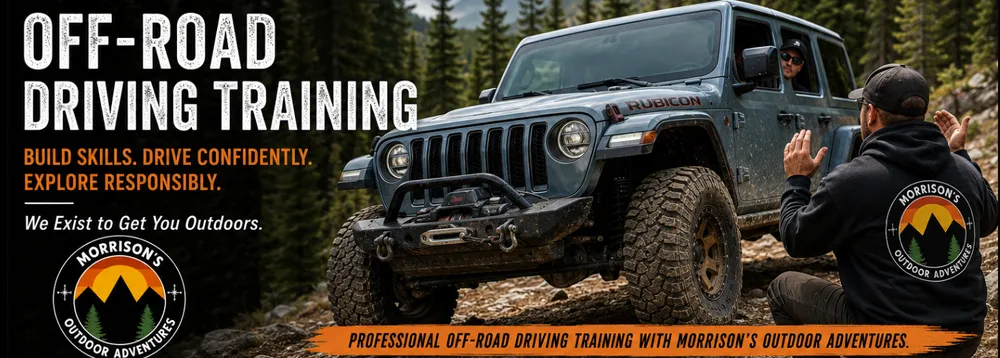
At Morrison’s Outdoor Adventures, our off-road driving training is designed to help drivers develop practical skills, confidence, and a better understanding of their vehicles through hands-on experience.
Whether you recently purchased your first Jeep, Bronco, truck, SUV, or AWD adventure vehicle, or you’ve been exploring off-road for years, there is always something new to learn.
Here are 10 essential skills every off-road driver should develop before heading farther down the trail.
1. Why Off-Road Driving Training Starts With Understanding Your Vehicle
One of the first steps in quality off-road driving training is understanding exactly what your vehicle can—and cannot—do.
Modern adventure vehicles can be equipped with an impressive collection of off-road technology, including:
- Four-wheel drive
- All-wheel drive
- Low-range gearing
- Locking differentials
- Traction-control systems
- Hill-descent control
- Terrain-management modes
- Crawl-control systems
- Electronic sway-bar disconnects
Unfortunately, many drivers purchase vehicles equipped with these features without ever learning exactly when or how they should be used.
Understanding your vehicle also means knowing its physical limitations.
Ground clearance, wheelbase, approach angle, departure angle, breakover angle, tire type, suspension, weight distribution, and drivetrain configuration can all affect how your vehicle performs on the trail.
Quality off-road driving training helps you understand how these characteristics affect your vehicle in real-world situations.
It also helps you recognize situations where the smartest decision isn’t pushing forward. Sometimes choosing another line, backing up, or turning around is the right decision.
Morrison’s Outdoor Adventures offers both 4WD and AWD education through our Education Pathway, allowing drivers to build skills appropriate for their vehicle and experience level.
2. Learn Proper Vehicle Placement
Good off-road driving isn’t about pointing your vehicle toward an obstacle and hoping for the best.
Vehicle placement matters.
Before entering an obstacle, you should evaluate where your tires need to travel and how the rest of the vehicle will move through the terrain.
That means paying attention to:
- Rocks
- Ruts
- Ledges
- Trees
- Drop-offs
- Holes
- Uneven surfaces
- Changes in elevation
A line that looks perfectly acceptable from behind the steering wheel may put a rocker panel, differential, bumper, or another part of the vehicle directly in harm’s way.
This is one of the biggest advantages of hands-on instruction.
An experienced instructor can help you understand what is happening underneath and around your vehicle—things that can be difficult to visualize while sitting in the driver’s seat.
Over time, you’ll begin recognizing better vehicle placement before entering an obstacle.
That’s when knowledge starts becoming confidence.
3. Master Throttle Control and Traction
More throttle isn’t always the answer.
In fact, one of the most important lessons drivers learn through off-road driving training is that smooth, controlled inputs often produce better results than simply adding more power.
Aggressive throttle can cause tires to spin, reducing available traction and potentially damaging the trail. It can also cause your vehicle to move unexpectedly when the tires suddenly regain traction.
Learning proper throttle control helps you maintain traction while navigating:
- Rocks
- Hills
- Loose gravel
- Mud
- Uneven terrain
- Ruts
- Changing surfaces
The objective isn’t speed.
The objective is control.
Understanding how throttle input, traction, gearing, terrain, momentum, and tire placement work together can dramatically change the way you approach an obstacle.
4. Off-Road Driving Training Teaches You How to Read Terrain
Experienced off-road drivers don’t simply look at what’s directly in front of their bumper.
They’re constantly evaluating the trail ahead.
One of the most important components of off-road driving training is learning how to recognize potential problems before your vehicle reaches them.
Before entering difficult terrain, ask yourself:
Where will my tires travel?
Is the terrain becoming steeper?
What’s on the other side of that rise?
Could the ground be softer than it appears?
Where will my vehicle’s weight shift?
Is there somewhere safe to stop?
Could the vehicle become high-centered?
What happens if I lose traction?
What’s my exit strategy if conditions become worse?
Learning to read terrain can prevent many problems before they ever happen.
When you’re uncertain about an obstacle, stop.
Get out.
Walk it.
Something that looks relatively simple through the windshield may look completely different when you’re standing beside it.
Never let impatience replace good judgment.
5. Understand Spotter Communication
Sometimes the driver simply cannot see where the vehicle needs to go.
That’s when a knowledgeable spotter becomes extremely valuable.
A spotter helps guide the driver through an obstacle by communicating information about:
- Tire placement
- Vehicle position
- Ground clearance
- Obstacles
- Direction
- Distance
- Potential hazards
But effective spotting requires communication.
Before attempting an obstacle, the driver and spotter should establish clear signals and expectations.
Ideally, one person should be responsible for directing the vehicle. Multiple people shouting different instructions can quickly create confusion.
The driver should also understand that if communication with the spotter is lost, the vehicle stops.
These communication and leadership skills become particularly important for drivers interested in progressing into Morrison’s Outdoor Adventures’ Skills Building Pathway, including Coach & Drive and Trail Guide training opportunities.
6. Learn How to Handle Hills Safely
Steep climbs and descents can be intimidating, particularly for drivers who are relatively new to off-road travel.
Understanding your vehicle’s drivetrain, gearing, traction systems, braking characteristics, and weight transfer can make these situations much more manageable.
Before attempting a hill, evaluate it.
Consider:
- Surface conditions
- Available traction
- Obstacles
- Vehicle capability
- Approach angle
- Departure angle
- What is beyond the crest
- Whether another vehicle is on the obstacle
- What you will do if the climb is unsuccessful
Never blindly drive over the crest of a hill when you cannot see what is on the other side.
And remember: knowing when not to attempt an obstacle is every bit as important as knowing how to complete one.
Confidence doesn’t mean attempting everything.
Confidence means being capable of making an informed decision.
7. Off-Road Driving Training Should Include Vehicle Recovery
Eventually, almost every active off-road enthusiast encounters a stuck vehicle.
It might be yours.
It might belong to someone else in your group.
Either way, knowing how to safely evaluate a recovery situation is an essential trail skill.
Recovery equipment may include:
- Winches
- Recovery ropes
- Kinetic ropes
- Shackles
- Soft shackles
- Traction boards
- Tree-protection straps
- Rated recovery points
- Other specialized recovery equipment
But simply owning recovery equipment doesn’t mean you know how to use it correctly.
Improper recovery techniques can damage vehicles and equipment and, more importantly, create serious hazards for the people nearby.
Proper off-road driving training should prepare drivers for situations where forward progress stops and vehicle recovery becomes necessary.
Morrison’s Outdoor Adventures offers dedicated Vehicle Recovery education that focuses not only on how recovery equipment works, but also on when and why different recovery techniques should be considered.
The best recovery begins with correctly assessing the situation before attaching equipment or attempting to move the vehicle.
8. Practice Responsible Trail Use
Learning to operate your vehicle is only part of becoming a responsible off-road enthusiast.
We also have a responsibility to protect the places that make these adventures possible.
Trail users should respect closures, stay on designated routes where required, minimize unnecessary environmental impact, properly dispose of waste, and respect other people enjoying public and private lands.
Tread Lightly! provides excellent information about responsible motorized recreation and protecting access to outdoor recreation areas.
At Morrison’s Outdoor Adventures, responsible recreation and stewardship are important parts of our approach to outdoor adventure.
We want future generations to have opportunities to experience these places too.
That requires all of us to enjoy them responsibly today.
Travel responsibly. Respect the trail. Protect the adventure.
9. Learn to Make Good Decisions Under Pressure
Technical driving skills matter.
But good decision-making may be one of the most valuable off-road skills you can develop.
Conditions can change quickly.
Weather moves in.
A trail becomes washed out.
Someone gets stuck.
A tire gets damaged.
A vehicle develops a mechanical problem.
The group starts running behind schedule.
An obstacle turns out to be significantly more difficult than expected.
Quality off-road driving training isn’t simply about teaching drivers how to overcome obstacles. It also teaches them how to evaluate situations and make better decisions when things don’t go according to plan.
When something happens, slow the situation down mentally.
Ask:
What is happening?
What are my options?
What risks are involved?
Do we have the equipment and experience required?
Is there a safer alternative?
Sometimes the right decision is continuing forward.
Sometimes it’s attempting a recovery.
Sometimes it’s choosing another route.
And sometimes it’s turning around.
Good judgment means knowing the difference.
10. Build Confidence Through Hands-On Off-Road Driving Training
Confidence doesn’t come from watching videos.
It doesn’t come from purchasing expensive equipment.
And it doesn’t automatically come with owning an extremely capable vehicle.
Confidence develops when knowledge and experience come together.
Hands-on off-road driving training gives drivers opportunities to learn techniques and then apply those techniques behind the wheel in real-world situations.
For newer drivers, Level 1 training can provide an excellent foundation.
Drivers who want to continue developing their abilities can progress into opportunities such as:
- 4WD Level 2
- AWD Level 2
- Vehicle Recovery
- Advanced Field Recovery
- Field Expedient Repair
- Coach & Drive
- Trail Guide Training
- Private Training
You can explore these opportunities on our Morrison’s Outdoor Adventures Pathways page.
The goal isn’t simply completing another class.
It’s becoming a more capable, thoughtful, and confident driver.
Off-Road Driving Training Isn’t Just for Beginners
There’s a common misconception that professional off-road driving training is only for someone who has never driven off-road.
That’s simply not the case.
Experienced drivers can benefit from professional instruction too.
Maybe you’ve been off-roading for years but have never received formal vehicle-recovery instruction.
Perhaps you’ve recently purchased a vehicle that behaves very differently from your previous rig.
Maybe you’re preparing for overlanding or remote travel.
You might be beginning to lead group trail rides and want stronger spotting, communication, or leadership skills.
Or perhaps there’s simply one particular skill you’ve always wanted to improve.
Morrison’s Private Training can be particularly valuable in these situations because training can be focused around your vehicle, experience level, goals, and the skills you want to develop.
There’s always another level of knowledge to gain.
Turn Your Training Into an Adventure
Learning the skills is only part of the journey.
Eventually, it’s time to use them.
Morrison’s Outdoor Adventures offers more than traditional education. Our Adventure Pathway gives participants opportunities to take their skills into the outdoors through experiences such as:
Trail Rides – Opportunities to experience different levels of trail driving while enjoying the outdoors.
Excursions – Multi-day adventures designed for those looking for a deeper outdoor experience.
Guided Tours – Explore incredible destinations while benefiting from experienced guidance.
Our philosophy is simple:
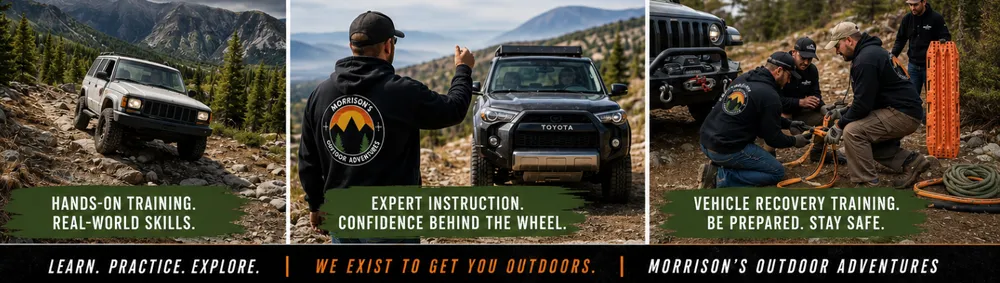
Learn. Practice. Explore.
Some people begin with formal education.
Others prefer hands-on coaching.
Some are ready to join a trail ride.
Others want a customized adventure.
There isn’t one path that works for everyone.
That’s why our Pathways are designed to help you find the experience that fits your goals.
Prepare Before You Hit the Trail
Even experienced drivers should prepare before every trip.
Before leaving pavement behind:
- Inspect your vehicle.
- Check your tires and tire pressure.
- Verify fluid levels.
- Research your route.
- Check weather conditions.
- Carry appropriate recovery equipment.
- Bring emergency supplies.
- Carry adequate food and water.
- Have appropriate navigation tools.
- Tell someone where you’re going.
- Know the regulations for the area you’re visiting.
When exploring federal public lands, resources from agencies such as the U.S. Forest Service can help you research recreation opportunities, motor-vehicle-use requirements, closures, permits, and other important information.
Never assume vehicle capability can replace preparation and good judgment.
Why Choose Morrison’s for Off-Road Driving Training?
At Morrison’s Outdoor Adventures, this isn’t simply about teaching someone how to drive over rocks.
Our mission is:
To reconnect families, groups, and individuals through the outdoors.
Professional instruction, hands-on learning, responsible recreation, confidence, family, and community are all part of that mission.
Mike Morrison is an International 4 Wheel Drive Trainers Association-certified instructor and a Master Tread Trainer with Tread Lightly!, with experience providing off-road and recovery instruction in recreational, commercial, utility, and military environments.
You can learn more about Mike, Sarah, their family, experience, and the story behind Morrison’s Outdoor Adventures on our About Us page.
Whether you’re completely new to off-road driving or looking for your next challenge, our goal is to help you become a safer, more knowledgeable, responsible, and confident driver.
Start Your Off-Road Driving Training Adventure
Your vehicle may be capable of taking you beyond the pavement.
The bigger question is:
Are you prepared to take it there?
Investing in professional off-road driving training gives you much more than a collection of techniques to memorize.
It teaches you how to understand your vehicle, evaluate terrain, manage traction, communicate with others, approach vehicle-recovery situations, respect the outdoors, and make better decisions when things don’t go exactly according to plan.
Those skills help turn uncertainty into confidence.
And confidence can open the door to incredible adventures.
At Morrison’s Outdoor Adventures, we believe some of life’s greatest memories are created when we leave everyday distractions behind and experience the outdoors together.
We Exist to Get You Outdoors.
Ready to begin?
Explore our Off-Road Training & Adventure Pathways, visit Morrison’s Outdoor Adventures to see upcoming opportunities, or contact Morrison’s Outdoor Adventures to find the right training or adventure for you.
Your next adventure starts with knowing you’re ready for it.